Inheritance Wars · Blended Families · Joint Property · High Court · 13 min read
Inheritance Wars: The Husband and Wife Who Died Together — and the £300,000 Question of Who Died First
Scarle v Scarle — when an obscure rule from 1925 decided which side of a family inherited everything
Peter Causton · 4 September 2026 · 13 min read
79 & 69
John and Marjorie’s ages
£280,000
Approximate reported value of the bungalow
£18,000
Joint bank account
One question
Who died first?
1925
The statutory rule which decided the outcome
It sounds like the opening of a legal examination question.
A husband and wife are found dead in their home.
Nobody knows precisely when either died.
Nobody can establish which survived the other.
They own their home jointly.
Each has a child from an earlier relationship.
Who inherits?
For the families of John William Scarle and Marjorie Ann Scarle, this was not an examination question.
It became High Court litigation.
And the answer turned upon a statutory rule which most members of the public will never have encountered:
The commorientes rule.
The case was The Estate of John William Scarle v The Estate of Marjorie Ann Scarle [2019] EWHC 2224 (Ch).
The result was effectively all or nothing.
Two deaths and two families
John Scarle was 79.
His wife Marjorie was 69.
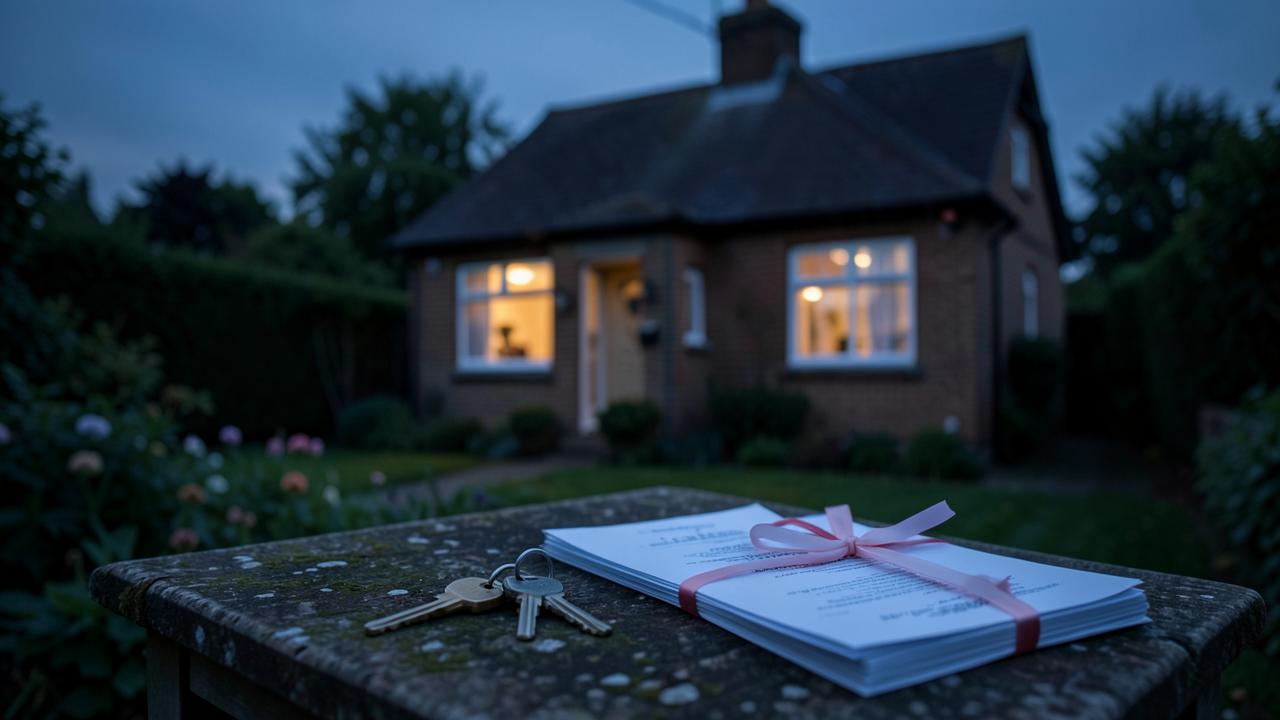
They lived together in a bungalow in Leigh-on-Sea, Essex.
Both had children from previous relationships.
On 11 October 2016, John and Marjorie were found dead in their home.
They had both died from hypothermia.
The evidence could not establish precisely when either had died — still less which of them had died first.
That uncertainty created an inheritance problem.
John and Marjorie owned their bungalow as joint tenants.
They also held approximately £18,000 in a joint bank account.
The bungalow was reported to be worth approximately £280,000, making the jointly held assets worth around £300,000 in total.
Why did it matter who died first?
Because jointly owned property held as joint tenants passes by survivorship.
If John died first, Marjorie became entitled to the jointly owned assets. Those assets would then pass under Mrs Scarle’s will.
If Marjorie died first, John would have survived her and the assets would instead have passed through his estate under his intestacy.
John’s daughter was Anna Winter.
Marjorie’s daughter was Deborah Cutler.
The order of two deaths therefore determined which side of this blended family received the property.
The difference might have been a matter of minutes or hours.
Financially, it was almost everything.
But nobody knew who died first
This was the fundamental problem.
There were no witnesses to the deaths.
The medical evidence could not establish a reliable sequence.
Anna relied upon evidence concerning the condition and decomposition of the bodies and argued that Marjorie had probably died first.
There were arguments about health, physical condition and the circumstances in which the couple were discovered.
But ultimately the judge was not satisfied that the evidence established the sequence of deaths even on the ordinary civil standard of the balance of probabilities.
So the court had to turn to a statutory rule.
Section 184 of the Law of Property Act 1925
Section 184 of the Law of Property Act 1925 deals with circumstances in which two or more people die and it is uncertain who survived whom.
Broadly, where the order of death is uncertain, the deaths are presumed to have occurred:
In order of seniority.
In other words, the older person is deemed to have died first. The younger is presumed to have survived.
John was 79.
Marjorie was 69.
The consequence was therefore stark.
If the evidence could not establish otherwise, John was legally presumed to have died first.
Marjorie was deemed to have survived him.
The jointly owned assets therefore passed to her by survivorship.
And from there they passed through her estate.
Simplified visual explainer
What happens if nobody knows who died first?
- 1
John — 79
- 2
Older person legally presumed to die first
- 3
Marjorie — 69
- 4
Younger person presumed to survive
- 5
Joint property passes to Marjorie by survivorship
- 6
Property then passes through Marjorie’s estate
A simplified explanation of the result in Scarle v Scarle, not estate-planning advice. Individual circumstances require legal advice.
Ten years made all the difference
John was ten years older than Marjorie.
That fact had nothing to do with who was actually more likely to survive in the circumstances.
Indeed, Anna’s case included arguments about their respective health and physical condition.
But the statutory rule exists precisely because sometimes the truth cannot be established.
The law needs an answer.
And where evidence cannot provide one, Parliament has supplied a presumption.
The court did not find as a historical fact that John definitely died first.
That distinction is important.
The court found that it could not establish who died first.
The statutory presumption therefore supplied the legal answer.
One family receives the property
The result was that Marjorie was deemed to have survived John.
The jointly owned assets passed to her.
Her estate therefore benefited from the house and joint bank account.
Anna Winter’s claim failed.
It is difficult to imagine a more binary result.
There was no judicial discretion to decide:
“Half each would be fair.”
The court had to determine the legal ownership of the assets.
Once the commorientes rule applied, the consequences followed.
Blended families and the survivorship trap
Scarle is much more than an unusual case about simultaneous deaths.
It illustrates a problem which can arise in thousands of modern families.
A couple marry later in life.
Both have children from previous relationships.
They own their home jointly.
They may assume:
“My children will ultimately get my half.”
But that is not necessarily what happens.
With a joint tenancy, there is no fixed half-share which automatically passes under the deceased’s will.
The property passes by survivorship to the other joint owner.
The survivor may then leave the entire property to their own children.
In many families that is exactly what the couple intends.
In others, it can produce a result neither side anticipated.
Could this have been avoided?
Potentially.
Careful estate planning can address what should happen where spouses have children from previous relationships.
Depending upon the circumstances and professional advice, arrangements may involve wills, trusts, severance of joint tenancies or other succession planning.
But by the time John and Marjorie had both died, those planning opportunities had gone.
Their daughters inherited the problem.
And then came another decision:
Whether to litigate it.
The extraordinary economics of the dispute
This is where Scarle becomes especially relevant to mediation.
The property was worth around £280,000.
There was approximately £18,000 in the joint account.
So the assets directly in issue were worth around:
£300,000.
Yet resolving who received them required expert evidence and a two-day High Court trial.
And the outcome was binary.
One side would receive the assets.
The other would not.
That is precisely the kind of litigation in which parties need to think carefully about risk.
What was Anna trying to prove?
Anna did not need to establish the precise minute at which either person died.
But she did need to prove, on the balance of probabilities, that Marjorie died before John.
That required the court to examine evidence about matters such as:
- the circumstances in the property;
- the location and condition of the bodies;
- medical evidence;
- decomposition;
- temperature;
- the couple’s health; and
- possible sequences of events.
HHJ Kramer concluded that the evidence did not permit the necessary finding.
The statutory presumption therefore remained decisive.
When litigation asks an impossible question
There is something almost philosophical about Scarle.
The court was being asked to reconstruct something which had happened in an empty bungalow days earlier.
There were only two people who knew the answer.
Both were dead.
Experts could provide opinions.
Lawyers could make submissions.
Witnesses could describe the couple’s health.
But ultimately:
Nobody knew.
The legal system nevertheless required an answer.
That is why presumptions such as section 184 exist.
Could mediation have produced a different answer?
Mediation could not establish who died first.
Nor could a mediator change section 184.
But mediation could have changed the question.
Instead of:
“Which of our parents died first?”
the daughters could have asked:
“Given that neither of us can know, how should we divide what they left?”
That is an entirely different exercise.
A court determines legal rights.
A mediation permits parties to negotiate an agreed outcome.
The reported 50/50 proposal
Contemporary accounts of the case report something particularly striking.
Before the litigation was pursued to judgment, Deborah Cutler is reported to have proposed mediation and an equal division of the estate.
That proposal was not accepted.
The litigation proceeded.
Deborah ultimately won the legal dispute.
The substantive reported judgment determines the legal issue; contemporary commentary reports that a 50/50 mediated resolution had earlier been proposed.
Half of something or all of nothing?
This is the classic settlement dilemma.
If approximately £300,000 is at stake, an equal division is worth approximately:
£150,000 each.
Litigation creates another possibility:
£300,000 or £0
subject, of course, to costs.
For someone convinced they will win, £150,000 can feel like giving away half of their entitlement.
But that is not the correct comparison.
The real comparison is between the certainty of settlement and the risk-adjusted outcome of litigation.
That calculation must include costs.
The emotional problem with compromise
Inheritance disputes make this particularly difficult.
A litigant may not think:
“I have a 60% chance of recovering £300,000.”
They may think:
“That was my father’s house.”
Or:
“Mum paid for that home.”
Or:
“My stepsister has no right to take our family’s money.”
Once an inheritance dispute becomes part of a family narrative, financial compromise can feel like moral surrender.
That is precisely where mediation can help.
Settlement does not require either person to agree about what is fair.
It requires them to decide what outcome they can accept.
A judge cannot split the difference
This is another important feature of Scarle.
A judge could not simply say:
“This is terribly uncertain, so I’ll award half to each daughter.”
Property law does not work that way.
The court had to decide whether the evidence displaced the statutory presumption.
It did not.
The consequences followed.
A mediator has no such limitation.
If both parties agree, they can split the assets 50/50, 60/40 or 70/30. One can take the house while the other receives cash. Property can be sold. Costs can be dealt with as part of an overall settlement.
That flexibility is one of mediation’s central advantages.
The lesson from Scarle v Scarle
Scarle is memorable because its facts are so unusual.
But the underlying problem is commonplace.
Second marriages. Children from earlier relationships. Jointly owned homes. Different testamentary arrangements. Assumptions about who will ultimately inherit.
Those ingredients exist in families throughout England and Wales — and they are among the reasons inheritance disputes continue to rise.
John and Marjorie’s deaths created an extraordinary legal question:
“Who died first?”
Nobody could answer it.
So a rule enacted in 1925 answered it for them.
But for their daughters, there had always been another question available:
“If nobody can know, can we agree to share the risk?”
That question belongs not to a courtroom, but to mediation.
ProMediate Inheritance, Probate & Trusts provides specialist mediation for disputes involving wills and inheritance, estates, jointly owned property, blended families, executors, beneficiaries and trusts. Mediation can take place before proceedings or at any stage of litigation.
Discuss a mediation → · Check mediator availability →
This article provides general information about mediation and Scarle v Scarle [2019] EWHC 2224 (Ch). It does not constitute legal or estate-planning advice.
Frequently asked questions
What is the commorientes rule?
Where two people die in circumstances making it uncertain who survived the other, section 184 of the Law of Property Act 1925 generally presumes, for relevant property-title purposes, that the deaths occurred in order of seniority, so the younger is deemed to have survived the elder.
What happens to a jointly owned house when one owner dies?
It depends how the property is held. Where owners hold as joint tenants, the deceased’s interest passes automatically to the surviving owner by survivorship. Where they hold as tenants in common, each owner’s distinct share can ordinarily pass under their will or intestacy. Individual circumstances require legal advice.
Cases referred to & sources
Discuss an inheritance, probate or trust mediation
ProMediate Inheritance, Probate & Trusts provides specialist mediation for disputes involving wills, estates, inheritance, trusts, executors, beneficiaries and family property. Mediation can take place before or during court proceedings, online or in person.
This article provides general information about mediation and the reported decisions referred to above. It does not constitute legal advice.
© 2026 ProMediate (UK) Limited. All rights reserved.
This article may not be reproduced, republished or substantially copied without the prior written permission of ProMediate (UK) Limited. Short quotations may be used for legitimate commentary or citation provided that ProMediate is clearly credited as the source.